A longitudinal neuroimaging dataset on language processing in children ages 5, 7, and 9 years old
This study investigates language development of chilren at 5, 7, and 9 years old. The experiment included diffusion- and T1-weighted structural magnetic resonance imaging (MRI), task-based functional MRI (fMRI), and a battery of psycho-educational assessments and parental questionnaires.
Download
- SRC Files
- Demographics
Source and Citation
https://openneuro.org/datasets/ds003604/versions/1.0.6 Please cite: Wang, J., Lytle, M.N., Weiss, Y. et al. A longitudinal neuroimaging dataset on language processing in children ages 5, 7, and 9 years old. Sci Data 9, 4 (2022). https://doi.org/10.1038/s41597-021-01106-3
Materials and Methods
 (https://doi.org/10.1038/s41597-021-01106-3)
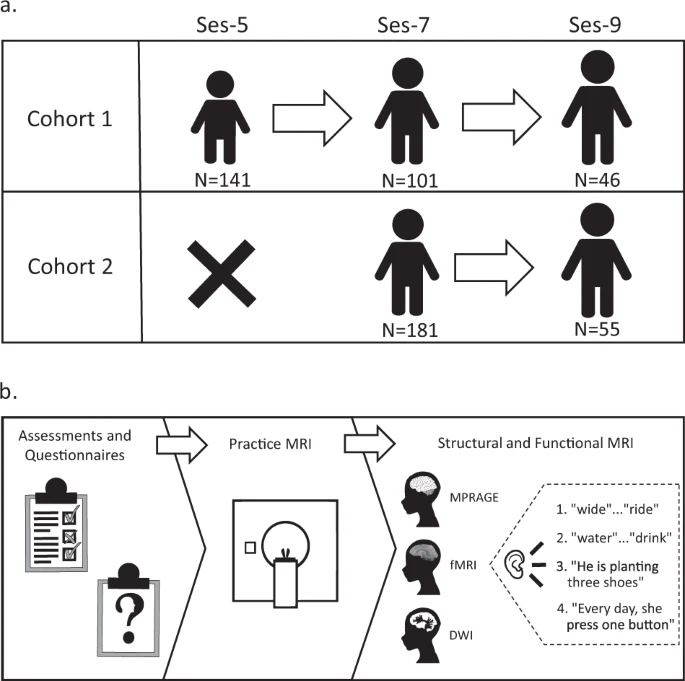
The study included 5.5-6.5-year-old children (ses-5) and followed them up when they were 7-8 years old (ses-7) and then again at 8.5-10 years old (ses-9). Another cohort of 7-8-year-old children (ses-7) were recruited and followed up when they were 8.5–10 years old (ses-9). In total, 322 children who completed at least one structural and functional scan were included.
Diffusion weighted images were collected using single-shot echo planar imaging (EPI) with the following parameters: GRAPPA accel.factor PE = 2, TR = 5000 ms, TE = 71 ms, field of view = 256 mm, matrix size = 128 × 128, bandwidth = 1502 Hz/Px, slice thickness = 2 mm, number of slices = 57, voxel size = 2 mm isotropic, flip angle = 90°, multi-band acceleration factor = 3, b-value1 = 0 s/mm2, b-value2 = 800 s/mm2, echo spacing = 0.75 ms, diff.directions = 64. Slices were acquired interleaved from foot-to-head.